


























AI virtual try-on shows shoppers how a garment looks on them before they buy. Which returns it prevents, which it does not, and how to judge payback on Shopify.
✦ KEY TAKEAWAYS
- Virtual try-on prevents appearance-mismatch returns, where the item arrives looking nothing like the photo. It does not prevent size returns, because it shows how a garment looks rather than recommending a size.
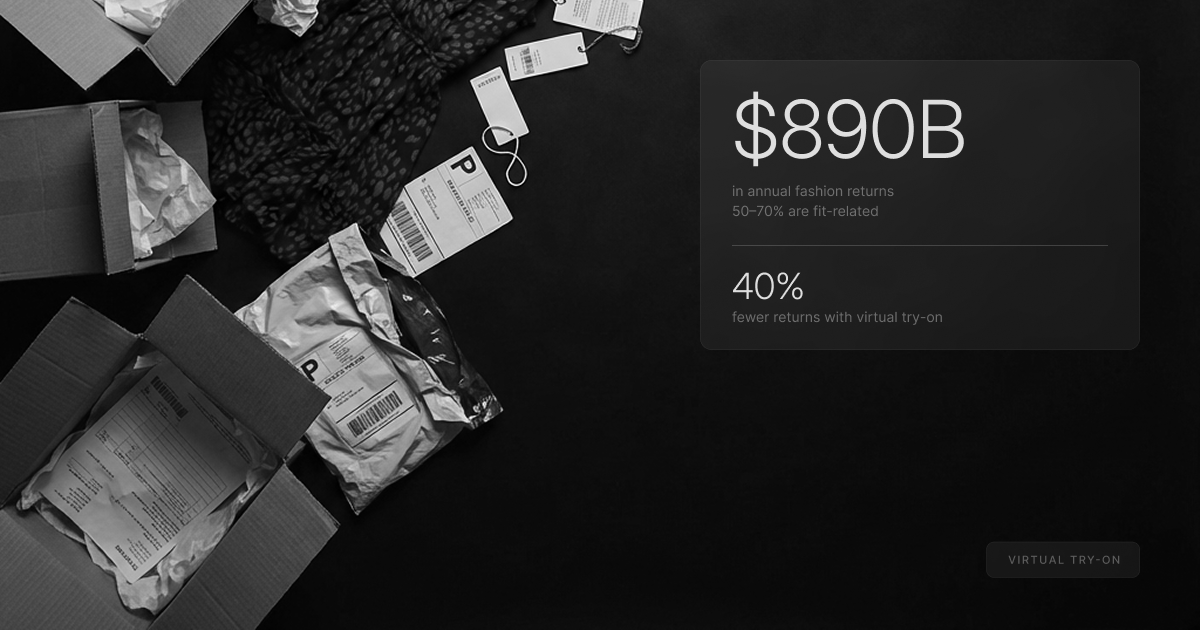
- Published benchmarks cluster in the 25–40% range, but Shopify's 40% figure measures 3D and AR experiences rather than image-based AI try-on (Shopify, 2026).
- Fit issues drive 50–70% of apparel returns. Processing each return costs $10–30 before the garment goes back on the shelf.
- Swim, body-con, activewear, and denim see the strongest results – categories where every millimeter of fit matters.
- Run the payback math on your own numbers: orders × return rate × cost per return × the reduction you actually measure.
Why Fit-Related Returns Are Eating Fashion Margin
US retail returns hit $890 billion in 2024 (NRF). Fashion takes a disproportionate share: online apparel return rates run 24–30%, roughly double the 16.9% ecommerce average (NRF, Statista 2025).
The Fit Gap
50–70% of those returns cite fit or appearance mismatch (Looksy, Shopify, multiple 2024–2026 studies). Fabric weight, drape, how a neckline sits – static images cannot communicate any of this. Each return costs the brand $10–30 in processing, shipping, and restocking.
Bracketing Compounds the Problem
25% of fashion returns come from bracketing – ordering multiple sizes, keeping one, returning the rest (Looksy, 2026). It is a rational response to fit uncertainty, not bad behavior. The brand absorbs $20–60 in return costs per bracketed order.
For a Shopify store doing $50K/month at a 30% return rate and $15 processing cost, that is $4,500/month in return handling alone – before lost resale value, support time, or restocking overhead.
✦ KEY TAKEAWAY Fit issues drive 50–70% of fashion returns at $10–30 each. Bracketing adds another 25%, with brands absorbing multiple return costs per order.
How AI Virtual Try-On Works: From Photo to On-Body Render
AI virtual try-on generates a realistic image of a shopper wearing a garment from a single uploaded photo. Current systems run on diffusion-based AI models trained specifically on fashion data – not generic image filters.
Three Steps, Seconds to Complete
1. Body estimation. The AI reads the shopper's photo – body shape, pose, proportions. No 3D scanning. A phone photo against a plain background works.
2. Garment simulation. The AI maps the product onto the body with fabric-specific physics. Silk drapes differently than denim. Folds, stretch, and wrinkle patterns are material-accurate, not a flat overlay.
3. Neural rendering. A photorealistic composite generates in seconds. Prints, logos, stitching, and texture transfer from the original product photo.
TryPoint runs on Google's diffusion-based models trained on fashion data. Processing happens on Google's cloud – zero page load impact, works on any device. 72% of fashion traffic is mobile (SaleCycle), so this matters.
Virtual Try-On vs. Fit AI
Merchants confuse these. Fit AI tells a shopper "you are a size M." Virtual try-on shows what the garment looks like on their body. One addresses sizing logic, the other visual confidence.
They solve different halves of the problem. Fit AI answers which size to order. Virtual try-on answers whether the garment is worth ordering at all, which is why it also lifts conversion rather than only preventing a return.
The Skepticism, Addressed
A fair critique: virtual try-on "just visualizes" without measuring fit. That is accurate, and it is the honest limit of the technology – it does not replace a tape measure, and it will not stop a shopper ordering the wrong size. What it does address is the other half of the problem: a shopper who cannot tell from a flat product photo whether a dress will flatter them. Shoppers do not need centimeter accuracy to make that judgement.
✦ KEY TAKEAWAY AI virtual try-on uses body estimation, fabric-specific simulation, and neural rendering to show shoppers how clothes look on them in seconds – on any device, with zero page speed impact.
The Return Reduction Data: What the Published Studies Measured
The return reduction claim is not a single study. Figures appear across Shopify, Snap, Google, and independent research over 2023–2026 – but they measured different technologies, and that distinction matters when you apply them to your own store.
The Benchmarks
- Shopify 3D/AR: 40% return reduction across merchants (Shopify, 2026)
- Snap Inc: 36% reduction, 2.4x purchase intent (2024–2026)
- Google AR: 65% less likely to return, 2.7x engagement (Shopify, 2026)
- Cliptics 11-retailer study: 35–45% return reduction, 2.3x conversion, cart abandonment from 73% to 51% (2026)
- Zalando: 40% reduction post-implementation (2023)
Read that list carefully. Most of these measured 3D or AR experiences, not image-based AI try-on of the kind TryPoint runs. They are useful as category evidence that showing a garment on a body changes behaviour. They are not a forecast for your store, and TryPoint does not publish a figure of its own.
Conversion Lift Adds More to the P&L
Return savings get the headlines. Conversion lift often contributes more to the bottom line. Cliptics found 2.3x median conversion across 11 retailers. Rebecca Minkoff reported 65% more likely to buy after AR interaction (Shopify).
For a store at the Shopify fashion average of 1.4–2.5% conversion, even a modest lift compounds on the same traffic and ad spend. Consumer adoption is accelerating: 58% of online fashion shoppers used VTO at least once in 2025, and 71% of Gen Z consider it essential.
✦ KEY TAKEAWAY The published benchmarks cluster in the 25–40% range, but most measured 3D or AR experiences rather than image-based AI try-on. Check what each study tested before applying it to your own forecast.
Which Fashion Categories Benefit Most from AI Virtual Try-On
VTO impact correlates directly with fit uncertainty in the category. The higher the fit stakes, the higher the return rate, and the bigger the payoff from virtual try-on.
Swimwear and body-con top the list – every millimeter of fit matters, and a flat-lay photo cannot show whether a bikini flatters. Denim is high-impact because a "size 28" differs by up to 2 inches between brands.
Oversized streetwear and basics benefit less because the fit problem is smaller. VTO still adds drape visualization value, but the ROI is lower.
TryPoint supports tops, dresses, swimwear, outerwear, and most upper-body garments – including back-view try-on for items where the rear design matters.
✦ KEY TAKEAWAY Swim, body-con, activewear, and denim see the highest return reduction from VTO. Oversized and basics still benefit, but the math is smaller because the fit problem is smaller.
The ROI Math: When AI Virtual Try-On Pays for Itself
Payback depends on three numbers you already know: return rate, monthly orders, and processing cost per return.
The Formula
Monthly savings = orders × return rate × cost per return × reduction %
Example: 1,000 orders/month, 30% return rate, $15 processing cost, 25% reduction (conservative):
1,000 × 0.30 × $15 × 0.25 = $1,125/month saved
That excludes conversion lift. A 2x conversion increase doubles revenue on the same traffic and CAC.
TryPoint Cost vs. Payback
TryPoint starts free (20 try-ons to test accuracy). Basic plan: $19.99/month for 100 try-ons. At $1,125/month in savings, payback is instant.
Even at lower volume – 200 orders/month, 25% return rate, $12 processing cost – monthly savings hit $150, covering the Basic plan 7x over. Cliptics found 6–14 weeks median payback across 11 retailers (2026).
What the Formula Misses
The $1,125 only counts return processing. It skips reduced support tickets, higher LTV from confident first purchases, email capture during try-on, and reusable UGC from shopper photos. McKinsey estimates widespread VTO adoption could eliminate $100–150 billion in annual return costs industry-wide.
✦ KEY TAKEAWAY A 1,000-order/month store with 30% return rate saves $1,125/month in processing alone. TryPoint at $19.99/month pays back in the first billing cycle – before counting conversion lift.
Frequently Asked Questions

